
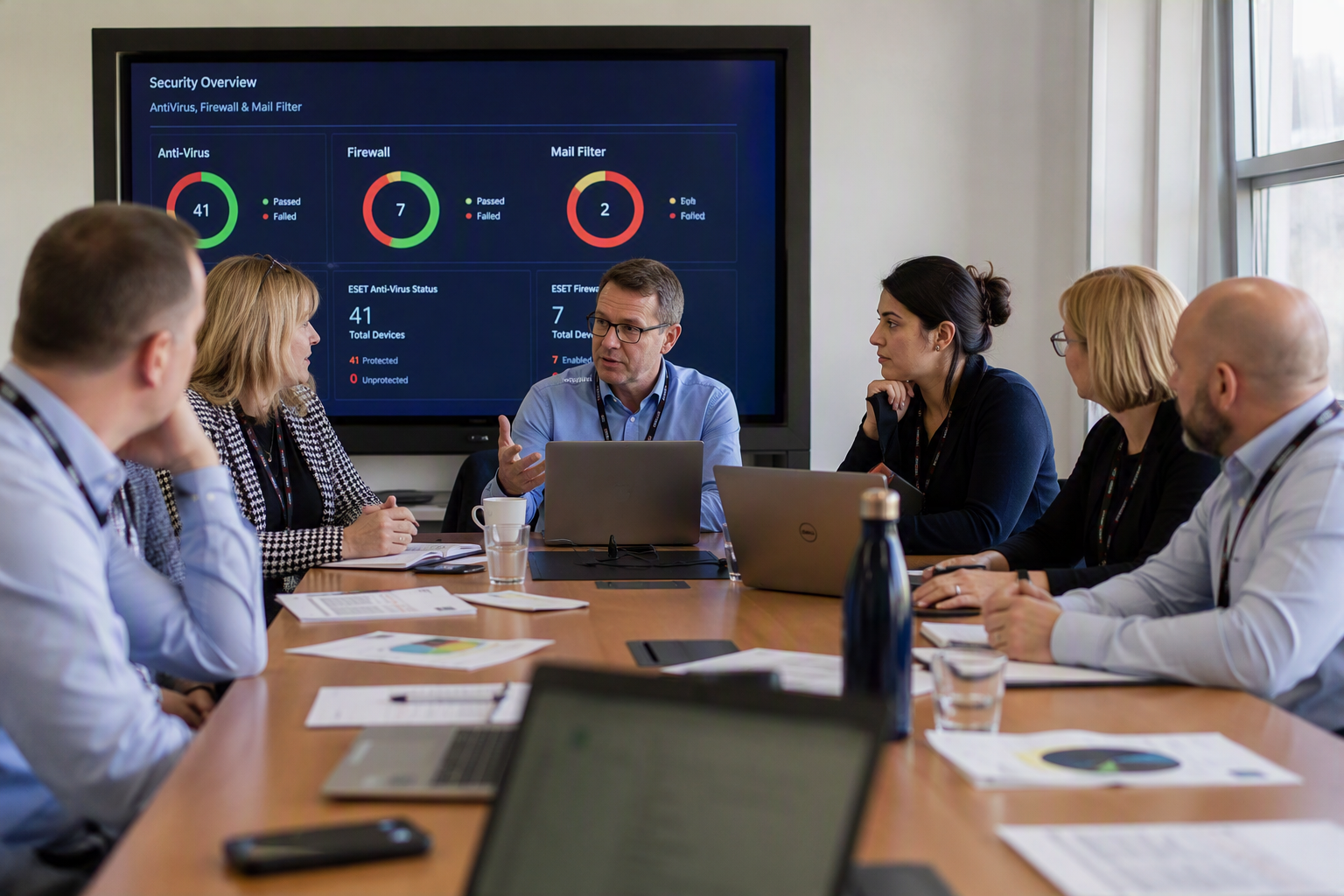
Cyber Security During Local Government Reorganisation: Why Transition Increases Risk
Local Government Reorganisation creates opportunity, but it also creates risk.
During transition, councils may operate across multiple environments, different identity models, separate security tools, varied supplier arrangements, inconsistent endpoint controls and different cyber maturity levels. That complexity can make it harder to understand where risk sits, who owns it and how quickly it can be reduced. The LGA’s work on Local Government Reorganisation highlights the importance of reinforcing cyber resilience, including MFA, privileged access controls, patching disciplines and tested incident response across predecessor councils. The LGA’s cyber, digital, data and technology research also found that effective technology and cyber functions are vital during organisational shift, helping councils transition safely and reliably. Cyber security cannot wait until after Day One, it needs to be part of the transition from the start.
Why LGR Increases Cyber Risk
Reorganisation creates a period of uncertainty and complexity.
Users may need access to multiple systems. Suppliers may need temporary access. Data may need to be shared between organisations. Legacy environments may remain in place. Support models may change. New collaboration spaces may be created at pace. Each of these creates potential risk.
Common challenges include:
- Inconsistent MFA coverage
- Different Conditional Access policies
- Unclear privileged access ownership
- Unmanaged or inconsistently managed devices
- Legacy systems with weak controls
- Gaps in monitoring and alerting
- Unclear incident response responsibilities
- Increased phishing risk during organisational change
- Excessive external sharing
- Temporary access that becomes permanent
- Duplicate suppliers and overlapping tools
The safest approach is to identify the risks early and manage them through a clear LGR cyber baseline.
Identity Is the First Line of Defence
Identity is one of the most important areas to review during LGR.
Councils should understand:
- Are all users protected by MFA?
- Are Conditional Access policies consistent?
- Are privileged accounts separated and protected?
- Are break glass accounts controlled?
- Are inactive accounts removed?
- Are guest accounts reviewed?
- Are administrator roles assigned appropriately?
- Are sign-in risks monitored?
- Are legacy authentication protocols disabled?
A new authority cannot build a strong digital workplace on weak identity foundations.
Identity decisions should be treated as security-critical programme decisions.
Privileged Access Needs Immediate Attention
Privileged access is a particular area of risk during reorganisation.
Multiple councils may have different administrative models. Some may use dedicated admin accounts. Others may have broader local administrator rights. Some may have mature privileged identity management. Others may rely on manual processes.
During LGR, councils should review:
- Global administrators
- Privileged role assignments
- Local administrator rights
- Service accounts
- Shared administrator accounts
- Supplier administrator access
- Emergency access accounts
- Privileged access logging
- Approval and review processes
The objective is to reduce unnecessary privilege before complexity increases.
Endpoint Security Must Be Aligned
Devices are often one of the largest risk areas in any transition.
Councils may have different hardware standards, operating system versions, patching processes, endpoint protection tools and device management platforms.
A practical endpoint cyber review should cover:
- Device inventory
- Management status
- Encryption
- Operating system support
- Patch compliance
- Defender configuration
- Security baselines
- Firewall policy
- Local administrator rights
- Application control
- USB and removable media policy
- Device compliance reporting
Moving towards a consistent Intune and Microsoft Defender approach can help reduce complexity and improve visibility.
Legacy Systems Create Exposure
Not every system can be modernised before Day One.
Some legacy platforms may remain necessary for service continuity. Others may be retained because of data, contractual or operational dependencies.
The risk is that these systems are forgotten or poorly governed during transition.
Councils should ask:
- Which legacy systems are business critical?
- Who owns each system?
- How are users accessing them?
- Are they exposed externally?
- Are they patched?
- Are backups tested?
- Is access logged?
- Are privileged accounts reviewed?
- What is the exit plan?
Legacy access may be unavoidable. Uncontrolled legacy access is not.
Incident Response Must Be Clear
During reorganisation, incident response ownership can become blurred.
If an incident occurs during transition, councils need clarity on:
- Who leads the response?
- Which security tools are monitored?
- Who contacts suppliers?
- Who communicates with senior leaders?
- Who handles legal and information governance requirements?
- Who manages user communications?
- Who coordinates recovery?
- How are lessons learned captured?
The LGA’s LGR guidance highlights tested incident response as part of cyber resilience planning.
Cyber response should be tested before Day One, not discovered during a live incident.
A Practical LGR Cyber Baseline
INTEGY recommends that councils establish a practical cyber baseline across predecessor organisations.
This should include:
- MFA and Conditional Access review
- Privileged access assessment
- Endpoint protection and compliance review
- Microsoft Defender configuration review
- Secure Score and exposure review
- Administrator and guest account review
- Legacy authentication review
- External sharing review
- Incident response readiness review
- Critical system access review
- Third-party access assessment
This does not need to be theoretical. It should produce a clear risk view, prioritised recommendations and actions that can be taken before Day One.
How INTEGY Can Help
INTEGY can support councils with an LGR Cyber Readiness Review focused on Microsoft cloud, identity, endpoint and access controls. Typical outputs include:
- Cyber baseline summary
- Identity and MFA findings
- Privileged access observations
- Endpoint management risks
- Microsoft 365 security recommendations
- Legacy access concerns
- Critical risk register
- Short-term remediation plan
- Executive summary for programme boards
Final Thought
Local Government Reorganisation changes how councils operate.
Cyber security must change with it. The councils that manage risk best will be those that understand identity, devices, access, monitoring, suppliers and legacy exposure early. LGR is an opportunity to strengthen cyber resilience, not inherit inconsistent controls.
INTEGY can help councils establish a practical cyber baseline before Local Government Reorganisation risk becomes operational risk.