
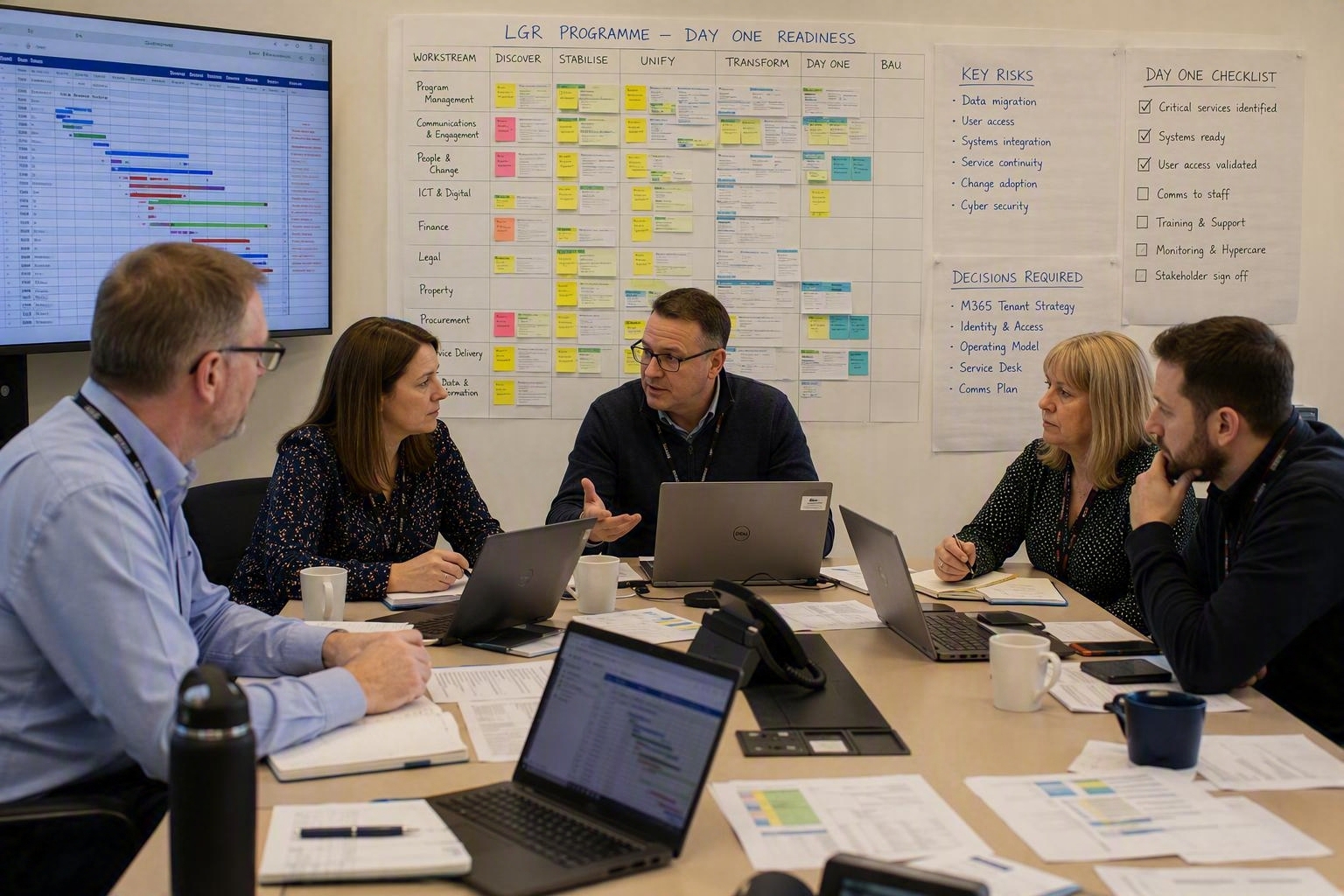
Day One Readiness for LGR: The IT Questions Every Council Should Be Asking
For councils preparing for Local Government Reorganisation, Day One is more than a milestone in a programme plan.
It is the point at which staff, systems, services, citizens, partners and elected members all expect the new authority to function.
The challenge is that much of the work required to make Day One successful sits beneath the surface. Identity platforms, devices, applications, contracts, data, networks, cyber controls, service desk arrangements and Microsoft 365 environments all need to be understood, aligned and governed. The MHCLG and Local Digital LGR Digital and Cyber Playbook has been created to help councils plan and deliver the digital, data, technology and cyber aspects of reorganisation, with a focus on preparing for vesting day, reducing risk and shaping the new authority.
The Core Day One Question
The most important question is not:
“Can we migrate everything by Day One?”
In most cases, that will not be realistic.
The more practical question is:
Can the new authority operate safely, legally and effectively from Day One while maintaining a clear path to future transformation?
That means councils need to distinguish between:
- What must be ready for Day One
- What can safely operate in transition
- What should be simplified after vesting day
- What should be retired, replaced or transformed
- What risks need executive visibility
This balance is critical. Trying to do too much before Day One can increase risk. Doing too little can leave the new authority with fragmentation, duplication and technical debt.
1. Do We Understand the Current IT Estate?
Before any decisions can be made, councils need a clear picture of what exists today.
Key questions include:
- What systems are used by each predecessor council?
- Which applications are business critical?
- Which systems support statutory services?
- What contracts and renewal dates exist?
- Which suppliers are involved?
- What integrations and data flows exist?
- Which systems are duplicated?
- Which systems are nearing end of life?
- Which platforms carry significant risk?
Without a current-state baseline, it becomes very difficult to make informed decisions about migration, consolidation or transformation.
The LGA’s LGR Toolkit exists to bring together practical resources, guidance, templates and lessons learned from previous reorganisations, reflecting the scale and complexity of the change involved.
2. Is There a Clear Identity and Access Strategy?
Identity is one of the most important technology workstreams in LGR.
If staff cannot authenticate, access email, open documents, use systems or collaborate securely, Day One will fail operationally.
Councils should ask:
- Which identity platforms are currently in use?
- Are all users protected by MFA?
- Are Conditional Access policies consistent?
- How are privileged accounts managed?
- How will joiners, movers and leavers be handled during transition?
- How will staff from predecessor councils collaborate?
- Which identity will users use on Day One?
- How will access to legacy systems be controlled?
A clear identity strategy should be developed early, with security, usability and governance considered together.
3. Are Devices Managed and Secure?
End-user computing is often one of the most visible parts of reorganisation for staff.
If devices are inconsistent, unmanaged or poorly secured, the new authority will face operational and cyber risk from the start.
Councils should understand:
- How many devices exist across all organisations?
- Which management platforms are in use?
- Are devices enrolled into Intune or another MDM platform?
- Are devices encrypted?
- Are operating systems supported?
- Are security baselines consistent?
- Are local admin rights controlled?
- Can users access the right services securely?
- Is there a plan for device refresh or standardisation?
The LGA’s digital, data and technology guidance highlights the importance of coordinated planning, including system mapping, cyber resilience, MFA, privileged access controls, patching and incident response.
4. Is Microsoft 365 Ready for Reorganisation?
Microsoft 365 will likely be central to collaboration, communication and productivity during LGR.
But it can also become a source of complexity if not properly governed.
Councils should ask:
- How many Microsoft 365 tenants are involved?
- Will the new authority use one existing tenant or a new tenant?
- How will email domains be managed?
- What happens to Teams, SharePoint and OneDrive data?
- Are retention policies aligned?
- Are sensitivity labels in use?
- Is external sharing controlled?
- Are licences duplicated?
- How will Teams sprawl be managed?
- Is the environment ready for Copilot in the future?
Tenant strategy is not just a technical decision. It has implications for records, security, user experience, collaboration, compliance and long-term operating model design.
5. Can Critical Services Continue During Transition?
Not every application will be migrated before Day One.
That means councils need safe and practical ways to maintain access to legacy systems while transformation continues.
Options may include:
- Existing managed laptops
- Secure VPN access
- Windows 365 Cloud PCs
- Application publishing
- Conditional Access controls
- Segmented access models
- Temporary support arrangements
- Controlled third-party access
The objective is not to solve every legacy challenge before Day One. The objective is to maintain service continuity while reducing risk and creating a route to simplification.
6. Is Cyber Risk Being Managed Across All Organisations?
LGR increases cyber complexity.
Multiple councils may have different controls, different suppliers, different monitoring tools, different incident response processes and different levels of maturity.
Councils should ask:
- Are MFA and Conditional Access consistently applied?
- Are privileged accounts reviewed?
- Is endpoint protection aligned?
- Are vulnerabilities being patched consistently?
- Is incident response tested?
- Are backups and recovery processes understood?
- Are third-party access routes controlled?
- Are legacy systems exposed?
- Is there a single cyber risk register for the programme?
The LGA’s LGR research specifically highlights that cyber, digital, data and technology functions are vital during organisational change, supporting safe transition and the opportunity for ongoing transformation.
7. Is the Service Desk Operating Model Clear?
Users will need support throughout transition.
If the support model is unclear, frustration and operational disruption can quickly escalate.
Councils should define:
- Who supports which users on Day One?
- Which tools are used for ticketing?
- How are incidents prioritised?
- How are major incidents handled?
- How are knowledge articles shared?
- How are common issues communicated?
- How will support transition over time?
- What reporting is required for programme governance?
The service desk should not be treated as an afterthought. It is one of the most important interfaces between the transformation programme and the workforce.
8. Is There an Executive View of IT Risk?
Boards and senior leaders do not need every technical detail, but they do need a clear view of risk.
A strong LGR technology risk summary should include:
- Critical dependencies
- Day One blockers
- Cyber risks
- Legacy access risks
- Supplier and contract risks
- Data and information governance risks
- Resource constraints
- Decision points
- Cost pressures
- Recommended mitigations
This allows digital, IT and cyber leaders to influence the wider programme at the right level.
How INTEGY Can Help
INTEGY can support councils with a focused LGR Digital Readiness Review, designed to identify practical risks, priorities and next steps.
Typical outputs include:
- Current-state technology summary
- Microsoft 365 and identity considerations
- Endpoint and device readiness assessment
- Cyber baseline observations
- Legacy access recommendations
- Day One readiness priorities
- Service desk and support considerations
- 90-day action plan
- Executive summary for programme boards